Fiona’s Story
Tracing a path from restless striving to spacious living, Fiona writes from hard-earned, quiet clarity.
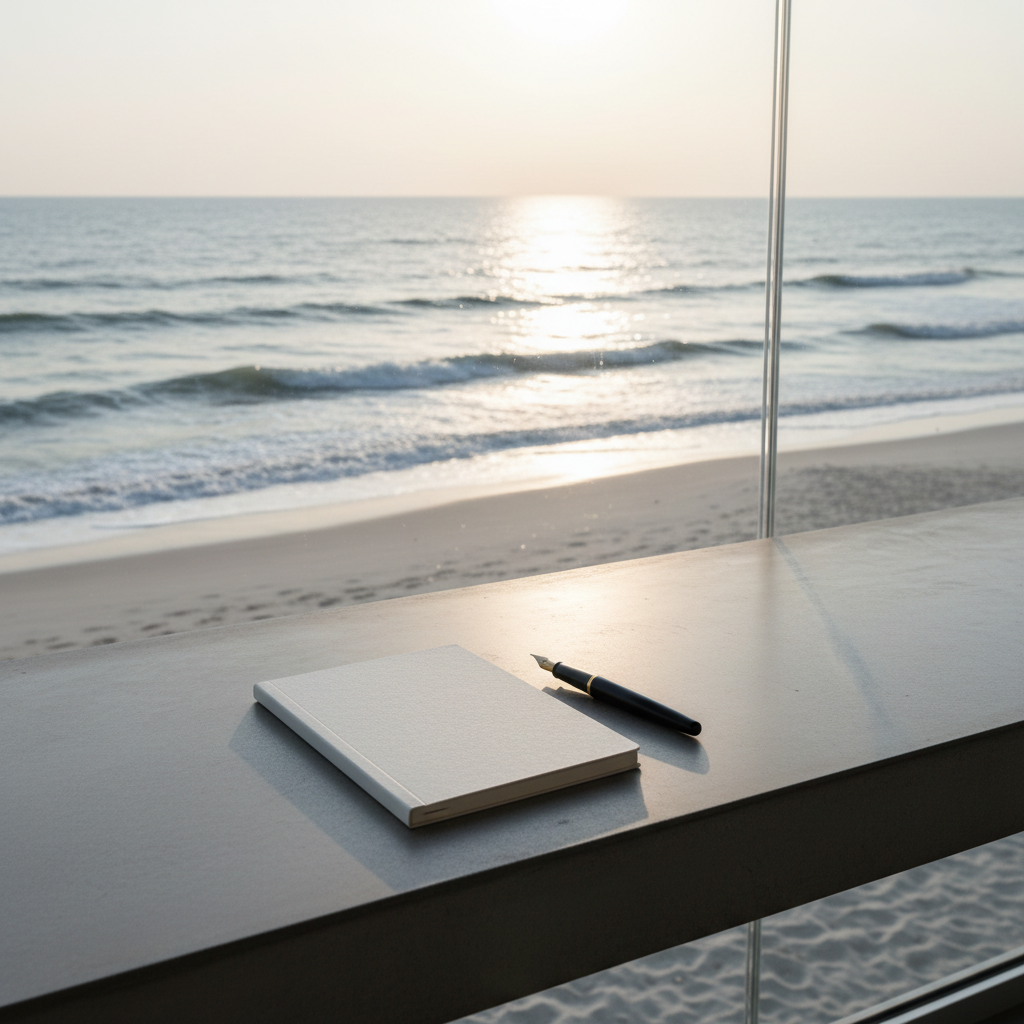
Early evening, the house is almost quiet. A cup of tea cools beside an open notebook, and somewhere outside a train moves through the distance, thin as a pencil line on the air. This is often how it begins for me: not with a grand idea, but with a small noticing that refuses to be waved away.
I have always been troubled by how easily a life can fill with noise. Emails, notifications, the dull roar of busyness that passes for importance. On the surface it looks like momentum; underneath, it can feel like a slow erasure. I write because I am trying not to disappear inside that noise. Writing is the way I ask, again and again: what would it mean to live at a truer pace, one that belongs to an actual human body and not to a machine?
The questions that follow me are mostly quiet ones. How much is enough, really, when we strip away the performance of success? What happens when we stop optimising every hour and allow some of them to be simply lived, unmeasured and unremarkable? Where is the line between comfort and excess, between responsibility and self-erasure? I do not have simple answers, and I am suspicious of anyone who claims they do. The work, for me, is to stay with the questions long enough that they begin to show their edges.
Again and again I return to slowness. Not as an aesthetic or a lifestyle trend, but as a form of resistance and repair. Slowness allows attention, and attention is the only way I know to recognise what is genuinely alive in a day: steam rising from a pot on the stove, the weight of a book in the hand, the small courage it takes to say no when everything around you is shouting yes, more, faster. I am interested in the kind of sufficiency that is not about shrinking a life, but about inhabiting it more fully.
Much of what I write circles these themes: how we choose to spend our brief time; what we keep and what we lay down; how to live more deliberately inside structures that rarely reward deliberation. The essays you will find here are, in one sense, field notes from my own attempts to live differently: experiments in saying this is enough, even when the culture insists that it cannot be. The shorter meditations are small resting places, pieces you might read in the space of a morning coffee, meant less to instruct than to companion you for a moment.
There are also longer works — books that trace these questions over months and years rather than days. They follow ordinary lives, mine among them, through seasons of work, care, loss, and quiet joy. No grand reinventions, no before-and-after miracles; just the slow work of trying to live with a little more honesty and a little less performance.
If you choose to stay, you will not find a five-step plan or a blueprint for a perfectly arranged life. What I can offer instead are carefully made sentences, honest attention, and a place where your own questions are taken seriously. Think of this as a small room at the edge of the louder world. The door is open. There is a chair by the window. You are welcome to sit for a while and see what comes to the surface.